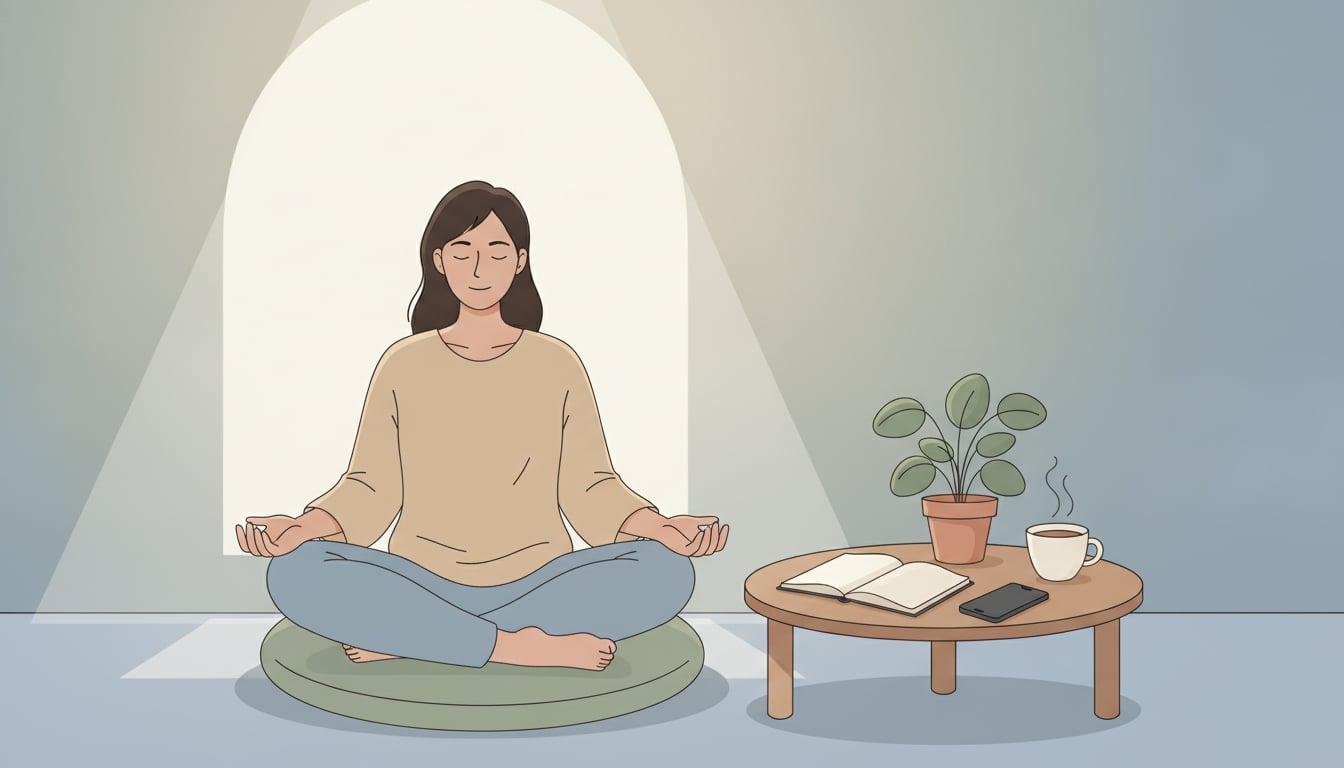
Note: This article shares tips for building everyday self-care habits and is not a substitute for medical diagnosis or treatment. If you're struggling, please consult a doctor or mental health professional.
You know you should breathe for five minutes before your inbox eats your morning. You know a walk without your phone would help. You know journaling for two minutes at night would clear your head. And yet, by 9 p.m., none of it happened — again — because something louder always showed up first. This article covers why self-care is the easiest good intention to break, and how My Rules turns it into small, AI-coached challenges you actually finish, using points and a journal to make the payoff visible instead of invisible.
Why Self-Care Falls Apart Even When You Know It Matters
It's never turned into an actual task, so it's the first thing cut
"Take care of yourself" isn't a task — it's a mood. There's no start time, no defined action, no clear finish line, so it has nothing to compete with when a meeting runs long or a deadline moves up. Everything else on your day has a name and a deadline; self-care has neither, so it's the first line item to get silently dropped. It's not that you don't want to rest or breathe or reflect — it's that "someday, generally" never wins against "due in ten minutes."
The payoff is invisible, so skipping it feels consequence-free
Even when you do carve out five minutes to breathe, nothing marks that it happened. No number goes up, no box gets checked, nothing distinguishes the day you meditated from the day you didn't. Compare that to your inbox, where ignoring it produces a visible, escalating pile. Self-care skipped today doesn't visibly cost you today — the cost shows up weeks later as burnout, and by then it's disconnected from any single missed session. Without a visible trace, your brain has no reason to prioritize it over anything louder.
Turning Self-Care Into a Game Instead of a Chore
The fix isn't more willpower or a longer to-do list — it's giving self-care the same structure that makes everything else in your day get done: a defined task, a clear finish line, and a payoff you can see. That's exactly what a self-care routine app can add that a vague intention can't.
Breaking a big goal into small challenges
"Take better care of my mental health" is too big and too vague to act on. My Rules' AI coach turns it into something you can start in the next five minutes: a short breathing break, one line in a journal, a walk with your phone left on the desk. Each challenge is small enough that it doesn't need a special mood or a free afternoon — it just needs the next five minutes, which is a resource you almost always have somewhere in your day.
Making effort visible with points makes it harder to quit
Every challenge you complete earns points the moment you mark it done. That's the missing piece from before — self-care finally leaves a trace. A short meditation isn't just "something I meant to do today," it's points on the board, sitting right there next to your other wins. Once the numbers start climbing and your progress starts filling up your history calendar, skipping a day stops feeling neutral — it feels like breaking something you've already built, which is a much stronger pull than a vague sense that you "should" meditate.
3 Steps to Build a Mental Wellness Habit With My Rules
Here's how to actually put this into practice with a mental wellness habit tracker that adapts to you instead of handing you a generic checklist.
Step 1: Tell your AI coach what self-care means to you
Self-care isn't the same for everyone — for you it might mean quiet mornings, for someone else it's movement, for someone else it's simply going to bed on time. Open a chat with your AI coach and describe what's actually draining you right now: "I'm mentally exhausted by evening and I doom-scroll instead of resting," or "I want to feel calmer before work starts." The coach uses that to suggest a small set of relevant challenges instead of a one-size-fits-all wellness list, so what you get actually matches your week rather than a stranger's idea of self-care.
Step 2: Complete small challenges and earn points
The coach hands you bite-sized tasks — a five-minute breathing break, a short walk, a screen-free hour before bed — each worth a set number of points. You complete one, tap it done, and the points land immediately. There's no waiting to "feel the benefit" before you get rewarded; the reward is the completion itself. Over a week, those points accumulate into a visible total on your history calendar, turning what used to be invisible effort into a running score you can actually watch grow.
Step 3: Reflect using the journal feature
At the end of the day, the journal feature gives you a place to note how a challenge actually felt — calmer, clearer, still tense, whatever's true. This isn't extra homework; it's what closes the loop between doing the thing and noticing it worked. A single honest line — "the walk actually helped today" — is often what convinces you to keep going tomorrow, because now you have evidence instead of just an intention.
Self-Care Challenge Ideas to Get You Started
If you're not sure where to start, these are exactly the kind of small, concrete tasks your AI coach can turn into scored challenges. Think of them as a starter kit for stress management habit-building — none of them require a free afternoon, just five focused minutes.
A 5-minute breathing or meditation break
Set a timer, close your eyes, and just breathe — in for four counts, out for six. You don't need an app tutorial or a perfect quiet room; a bathroom break or the five minutes before a meeting starts works fine. Log it as done and watch the points land — that immediate acknowledgment is what turns "I should meditate sometime" into something you actually did today.
A one-line gratitude journal entry
Before bed, write one sentence about something that went right today — nothing elaborate, just one specific, real thing. "The coffee was good" counts. The point isn't literary quality; it's training your attention to notice something positive before you fall asleep, which is a small, cheap counterweight to a day that mostly ran on stress.
A 30-minute digital detox before bed
Put your phone in another room half an hour before you plan to sleep. Read, stretch, talk to whoever's around, or just sit there — the point is breaking the scroll-until-you're-tired pattern that keeps your brain wired right when it needs to wind down. It's a hard habit to start cold, but as a scored, five-minute-to-set-up challenge, it's a lot easier to actually try tonight.
Takeaway: Small Self-Care Wins Add Up
Self-care doesn't fail because you don't care about it — it fails because it's vague and invisible, and vague, invisible things lose to whatever's loudest right now. Turn it into small, defined, scored challenges, and it finally competes on the same terms as everything else on your plate. My Rules is free to start — challenges, points, the history calendar, notifications, and the journal are all included — with premium adding unlimited AI coaching and no ads for a low monthly price whenever you want more from your coach.
If difficult feelings persist or start affecting your daily life, please don't carry them alone — reach out to a doctor or mental health professional.