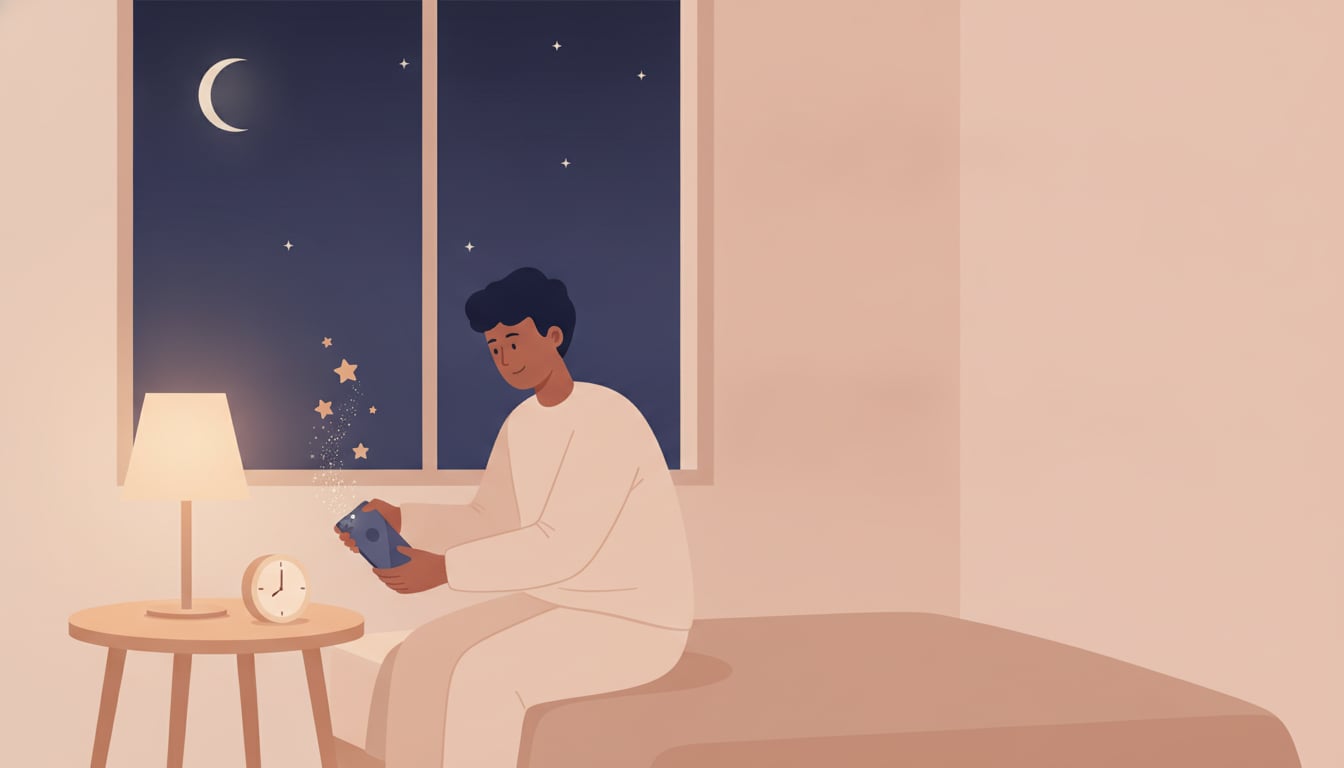
You promised yourself you'd be asleep by 11. It's 1:14 a.m. and you're still scrolling. Tomorrow you'll drag yourself through the morning on coffee, swear you'll go to bed early tonight, and then do the exact same thing again. If you've been searching for how to stop staying up late, here's the good news: you're not lazy, and you're not broken. This isn't a discipline problem. It's a design problem. Your evening is set up so that staying awake always wins. In this article you'll see why that happens, why willpower alone keeps failing, and how to rebuild your night so that going to bed earlier actually feels rewarding.
What Is Revenge Bedtime Procrastination?
Revenge bedtime procrastination is when you give up sleep to win back free time that the day took from you. Work, commuting, chores, messages, other people's needs — by the time all of that is done, there's barely an hour left that belongs to you. So you stretch it. One more episode. One more match. Another twenty minutes of videos you won't remember tomorrow.
It isn't really about the phone or the show. It's about control. Staying up late is a quiet protest against a day that didn't leave room for you. That's why it's so common among busy professionals, remote workers whose job bleeds into the evening, and students juggling classes with everything else. The busier the day, the stronger the pull to "take the night back" — even when you know you'll pay for it in the morning.
Why You Keep Pushing Your Bedtime Back
Night feels like the only time that's yours
During the day, your time is spoken for. Meetings, deadlines, family, notifications. The evening is the first stretch where nobody needs anything from you, so your brain treats it as precious. Going to bed feels like ending the only good part of the day early. That's why "just go to sleep" sounds so unappealing: it asks you to give up the one thing you actually look forward to. Any plan that only takes the night away, without giving something back, is going to lose.
Your willpower is drained by 10 p.m.
By late evening you've made hundreds of small decisions and resisted dozens of small temptations. Self-control is a limited resource, and it's at its lowest exactly when you need it to close the laptop and walk away. So the decision to stop is left to the most tired version of you. Of course it loses to autoplay. Expecting a worn-out brain to make the disciplined choice every night is like expecting a phone at 3% battery to run all evening.
Sleeping early has no instant payoff
Here's the biggest trap. The benefits of sleep arrive tomorrow — better focus, steadier mood, more energy. The benefits of staying up arrive right now. Your brain heavily favors rewards it can feel immediately, so a vague promise of "feeling better tomorrow" can't compete with the next video starting in five seconds. Going to bed earlier is the right choice with no reward attached. Staying up is the wrong choice with a reward attached. Guess which one wins.
How My Rules Turns Your Bedtime Into a Game
If the problem is that sleep has no instant payoff, the fix is to add one. My Rules turns your evening into small, scored actions, so putting the day down finally comes with a win you can feel tonight, not just tomorrow.
The AI coach builds a 20-minute wind-down routine
Tell the AI coach what you're struggling with — "I keep scrolling until 1 a.m." — and it breaks your evening into short, 5-minute steps you can actually follow when you're tired. Dim the lights and tidy your desk. Put your phone on the charger. Wash up and change. Read a few pages of a paper book. Four small steps, about 20 minutes, and none of them require a burst of motivation. You're not fighting the night anymore. You're just doing the next easy thing.
Earn points the moment you put your phone down
Each step becomes a challenge with points you choose. For example: "Phone on the charger by 10:30 p.m. = 3 points." The moment you tap it done, the points land. That instant reward is exactly what was missing. Now the choice to stop scrolling isn't just "the responsible thing" — it's a small win, right now. And every night you hit your bedtime gets marked on the history calendar, so after a week you can see a run of good nights you won't want to break.
Reminders that nudge you before "one more episode"
Willpower fades late at night, so don't rely on remembering. Set a push reminder for your "start winding down" time — say, 10:15 p.m. When it pops up, it interrupts autoplay before the next episode grabs you. It's a nudge from the version of you who made the plan earlier in the day, when your head was clear. A good reminder doesn't nag. It just shows up at the right moment.
How to Go to Bed Earlier: A 3-Step Plan
The app gives you the feedback loop. These three steps show you how to go to bed earlier without trying to overhaul your entire life in one night.
Step 1: Work backward from your wake-up time
Start with the time you actually need to get up, then count back the hours of sleep you want. If you wake at 7 a.m. and want around 7.5 hours, lights out is roughly 11:30 p.m. Your wind-down starts 20 minutes before that. Now your bedtime isn't a vague wish — it's a number with a reason behind it. To make it stick, pair it with a morning routine; see how to stick to a morning routine for how to make the other end of the day work too. An earlier night makes an easier morning, and an easier morning makes the next night easier.
Step 2: Start with one rule: phone off 30 minutes before bed
Don't try to fix everything at once. Pick one rule and make it a challenge: phone off 30 minutes before bed. That's it. The phone is where most revenge bedtime procrastination happens, so this single rule does most of the heavy lifting. Put the charger outside your bedroom if you can. Once this rule feels automatic for a couple of weeks, add another step from your wind-down routine. Small rules that survive tired nights beat ambitious plans that collapse by Thursday.
Step 3: Close the day in your journal and pick tonight's reward
Before lights out, open the journal and write two quick lines: what went well today, and one thing to improve tomorrow. It takes two minutes, and it gives your brain a clear signal that the day is finished — nothing left to "take back." Then decide what tonight's points are building toward. Maybe a week of on-time nights earns you a slow Saturday morning at your favorite café. A reward decided in advance gives tired-you a reason to follow through.
Common Questions About Going to Bed Earlier
What if I can't fall asleep when I go to bed early?
That's normal at first. Your body clock doesn't shift overnight. Instead of jumping two hours earlier, move your bedtime 15 minutes earlier at a time and hold it for a few days before moving again. Keep the wind-down routine the same every night so your body learns the cue. If you still can't sleep after weeks of trying, or sleep problems keep coming back, talk to a doctor — this article is about habits, not medical advice.
Can I stay up late on weekends?
A little. Try to keep your weekend bedtime within about one hour of your weekday bedtime. A bigger swing makes Monday feel like jet lag. If you want more flexibility, set up a separate weekend challenge with its own bedtime and points, so the weekend still counts instead of breaking your rhythm.
The Takeaway: Protect Your Evening, Then Protect Your Sleep
Staying up late isn't a character flaw. It's what happens when your night has no structure and sleep has no reward. Here's how to flip that:
- Name it. Revenge bedtime procrastination is about reclaiming time, not about being weak.
- Make it small. One rule — phone off 30 minutes before bed — beats a perfect plan.
- Make it rewarding. Points, reminders and a quick journal entry give tonight its own payoff.
Protect the evening time that's truly yours, then let it end on purpose. Give My Rules a try tonight. The free plan includes challenges, points, reminders (push notifications) and the history calendar; premium adds unlimited AI coaching for a low monthly price.