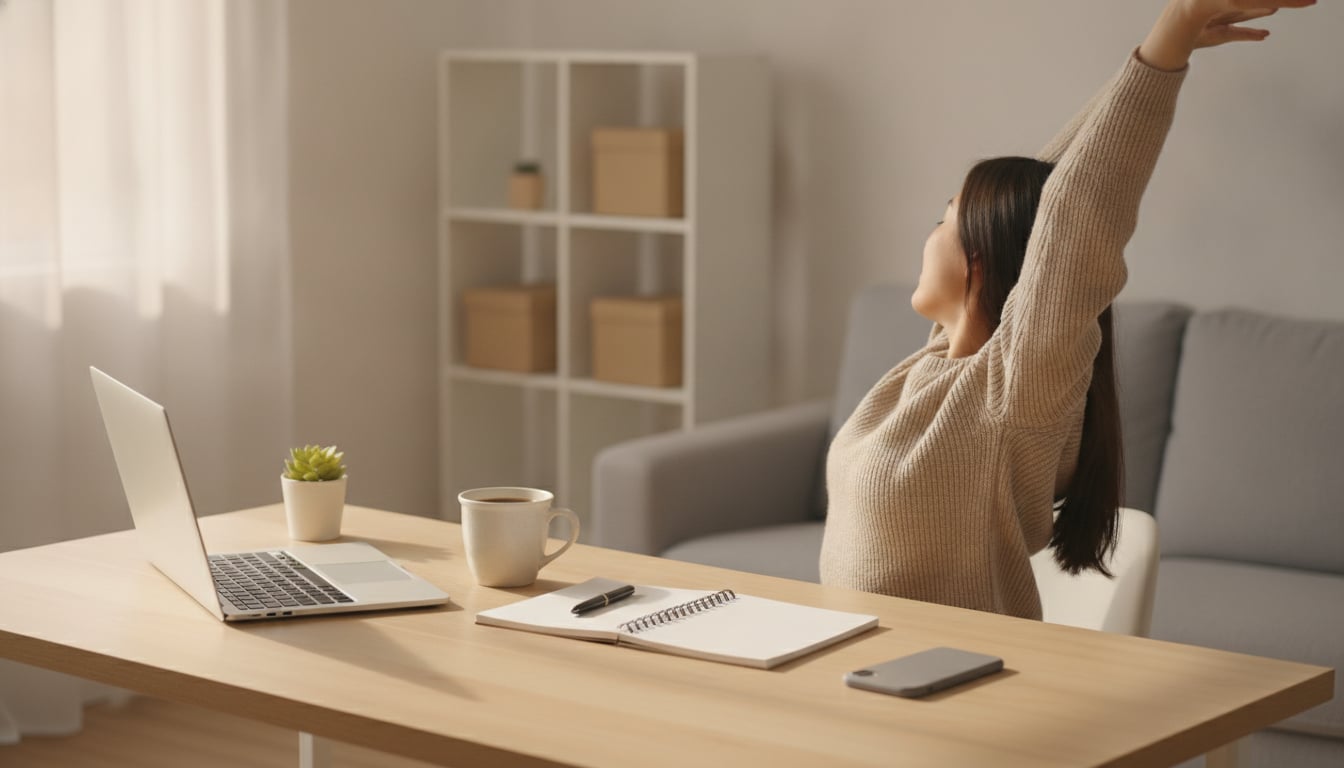
It's 7:45 a.m. and you're answering email from bed, still in yesterday's T-shirt. Lunch happens over the keyboard. At 8 p.m. the laptop is still open on the kitchen table, and you can't quite say when the workday ended — or whether it did. If that sounds familiar, you don't need more discipline. You need a work from home routine: a handful of small rules that give your day the shape an office used to give it for free. The good news is that it's not a willpower problem. It's a structure problem, and structure is something you can build.
Why Working From Home Throws Off Your Day
Before you can fix the blur, it helps to see where it comes from. Most of what made an office day feel organized wasn't the work itself — it was everything around it.
There's no commute to switch you into work mode
Love it or hate it, the commute did a job. Walking to the station, sitting in traffic, grabbing a coffee on the way in — all of it told your brain, "We're heading to work now." At home, the gap between waking up and working can shrink to the ten seconds it takes to unlock your laptop. With no transition, you never fully arrive, so the morning drifts and focus shows up late, if at all.
Your desk is also your living room
In an office, the place you work is only for work. At home, the couch is right there, the laundry is in your line of sight, and your phone sits within arm's reach all day. Every one of those is a small invitation to switch tasks. Learning how to stay productive while working from home is mostly about reducing those invitations, not about trying harder to ignore them.
Nobody tells you when to stop
The office emptied out at the end of the day. Colleagues packed up, the lights dimmed, and you went home. Remotely, there's no signal. One more email turns into one more hour, and because work lives in the same room as the rest of your life, it never quite leaves. Without a clear finish line, evenings get eaten a little at a time.
How to Build a Work From Home Routine (Without a Rigid Schedule)
An office gives you transitions automatically. At home, you build them yourself — not as a minute-by-minute timetable, but as a few simple rules you follow every day.
Anchor each rule to a cue, not a clock time
"Start work at 9:00" breaks the first time a morning goes sideways. A cue-based rule holds up better: "After I pour my coffee, I write my top three tasks." The cue already happens every day, so it carries the new behavior along with it. Clock times still matter for meetings, but the rules that shape your day work best when they're attached to something you already do.
Start with three rules, not ten
It's tempting to design the perfect day all at once. Don't. Pick one rule for the morning, one for midday, and one for the end of the day. Three rules are easy to remember and easy to keep, and they cover the three moments where WFH days usually fall apart: starting, pausing, and stopping. Once those run on autopilot, you can add more.
Schedule your breaks like meetings
Breaks are the first thing to disappear when nobody's watching. Treat them as rules too. Put a lunch block on your calendar, and decide in advance what a break looks like — stepping outside, refilling your water, standing up and moving away from the screen. A break you planned is a break you'll actually take.
One note: your rules should fit inside your employer's working hours and remote-work policies, not replace them. If you're unsure what's expected, check with your manager or HR.
Sample Work From Home Schedule: Rules for Morning, Midday, and End of Day
Here's a simple work from home schedule built from small rules instead of fixed hours. Borrow it as-is, or swap in rules that suit your job and home.
Morning: the fake commute
A fake commute is a short ritual that stands in for the trip to the office. Walk around the block before you sit down. Get dressed as if someone might see you — even if nobody will. Clear your desk and open only the tools you need for your first task. The point is a clear "now I'm at work" moment, so the morning doesn't leak into email in bed.
Midday: focus blocks and real breaks
Split your day into focus blocks: a stretch of time on one task with notifications muted and your phone in another room. Between blocks, stand up and step away from the desk, even for a couple of minutes. And eat lunch somewhere that isn't your workspace — the kitchen table, the balcony, a bench outside. It's a small change that makes the day feel like it has a middle.
End of day: the shutdown ritual
A shutdown ritual is the fake commute in reverse. Write down tomorrow's first task so you don't carry it around all evening. Close the laptop instead of leaving it half-open. Then put work gear out of sight — in a drawer, a bag, or just a different room. When work is no longer visible, it's much easier to stop thinking about it.
Here's how those rules might look as a points-based checklist. The point values are just examples; set whatever feels right to you.
| Time of day | Rule | Example points |
|---|---|---|
| Morning | Walk around the block before work | 10 pts |
| Morning | Get dressed for the day | 3 pts |
| Morning | After pouring coffee, write my top 3 tasks | 5 pts |
| Midday | Finish one focus block with my phone in another room | 10 pts |
| Midday | Eat lunch away from my desk | 5 pts |
| Midday | Stand up and step away between tasks | 3 pts |
| End of day | Write tomorrow's first task | 5 pts |
| End of day | Close the laptop and put work gear out of sight | 10 pts |
What to Do When Your Routine Falls Apart
It will. Meetings run over, a kid gets sick, a deadline lands at 4 p.m. on a Friday. None of that means the routine failed. On a messy day, keeping just one rule still counts — maybe you skipped the walk but still closed the laptop on time. That's a win worth logging.
If the same rule keeps slipping week after week, the rule is the problem, not you. Shrink it ("walk around the block" becomes "step outside for two minutes") or swap it for something that fits your day better. And if you've fallen off completely, there's a gentle way back — see how to get back on track with habits for a step-by-step restart.
Turn Your WFH Routine Into a Game With My Rules
My Rules is a habit tracker that turns rules like these into a game. Each habit becomes a "Challenge," and every time you complete one, you earn points. You decide the rules and the point values yourself, and rest can earn points too — so a real lunch break counts as much as a focus block if you want it to.
Push notifications can remind you at set times for each challenge, like a nudge at the end of the day to start your shutdown ritual. A daily reflection journal lets you note what went well and what to improve, and your point history shows up on a calendar so you can see your week at a glance. If you're not sure where to start, the AI coach suggests challenges and rewards — it suggests, and you decide.
Free to start (with ads); Premium is a monthly in-app purchase that removes ads and unlocks unlimited AI coach chats. It's available on iOS and Android.
The Bottom Line
Working from home takes away the built-in transitions an office gives you — the commute, lunch out, leaving the building. You can build them back with a few small rules tied to cues you already have. Don't redesign your whole day. Pick one morning rule, one midday rule, and one end-of-day rule, and try them tomorrow. Once they stick, add the next one.

